A fire extinguisher is a backup tool, not a reason to remain inside a burning apartment. Home fires can become life-threatening within minutes, while smoke can rapidly obscure familiar rooms and impair judgment.Ready.gov Your first system is therefore working alarms, two usable ways out where possible, a practiced meeting place, and immediate evacuation. NFPA advises residents to get out immediately when an alarm sounds and never re-enter a burning building.National Fire Protection Association
Only a trained adult should consider using an extinguisher—and only against a very small, contained fire when everyone else is leaving, emergency help has been called, the correct extinguisher is ready, and a clear exit remains behind the user. If smoke is accumulating, heat is increasing, the fire is spreading, the extinguisher is unfamiliar, or you feel uncertain, leave immediately and close doors behind you if possible.U.S. Fire AdministrationNational Fire Protection Association
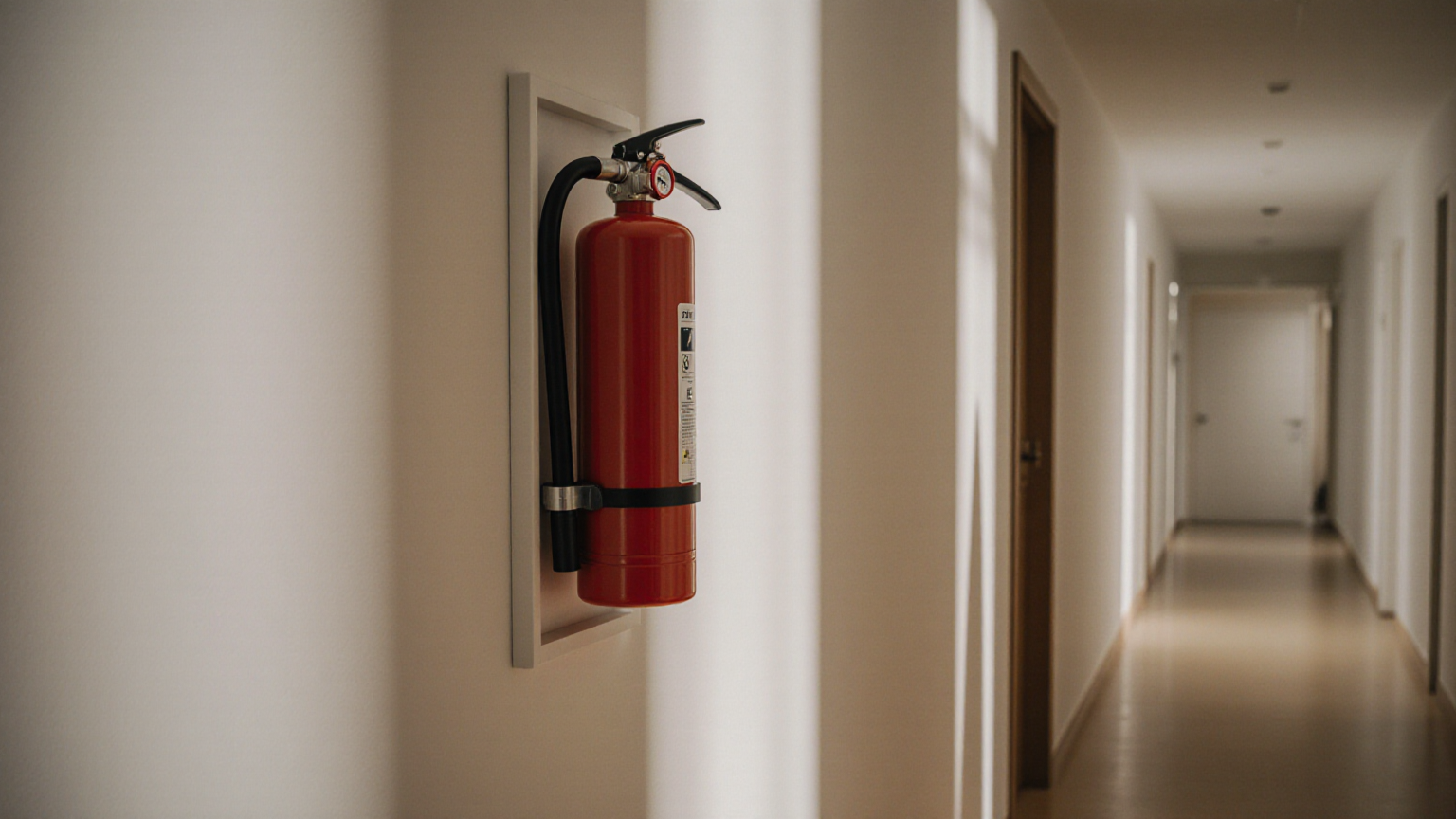
Start with the escape route, not the appliance
In a small apartment, the most obvious extinguisher location is not always the safest. A unit beside the stove may become unreachable precisely when it is needed. A cylinder hidden under a crowded sink may take too long to retrieve. A heavy model mounted above shoulder height may be unusable for some residents.
Use this renter-friendly sequence:
- Mark the primary exit. Usually this is the apartment entry door leading to a protected corridor, stair, or exterior route.
- Mark secondary exits. Include an accessible balcony door or window only if it is a realistic escape route under your building’s plan. Never assume an upper-floor window is usable without suitable equipment and instructions.
- Trace the normal walking path from the bedroom and living area to the primary exit.
- Identify likely ignition areas: the cooktop, countertop appliances, electrical equipment, portable heaters, laundry equipment, and candles.
- Choose a point near an exit-side approach, not a point that requires moving toward or through a likely fire.
- Test access with a timer. A capable adult should be able to see, reach, release, and lift the extinguisher in a few seconds without moving furniture or opening a jammed storage area.
- Confirm that placement does not narrow the exit route, create a shin-level obstacle, or interfere with doors.
These are practical access tests, not universal code dimensions. Building rules, local fire codes, extinguisher instructions, and lease terms can impose different requirements.
Match the extinguisher to the hazard
The label matters more than the cylinder’s color. In the United States, Class A covers ordinary combustibles such as paper, wood, and cloth; Class B covers flammable liquids; and Class C identifies an agent suitable around energized electrical equipment. Multipurpose ABC extinguishers are commonly available for household hazards.U.S. Fire Administration
Class K is intended for fires involving cooking oils and fats in cooking appliances and is most often associated with commercial kitchens.U.S. Fire Administration A renter with unusual equipment—such as a large deep fryer, workshop materials, or stored fuel—should ask the local fire department or another qualified authority what protection is appropriate rather than assuming one household ABC unit covers everything.
The rating also communicates capacity. USFA explains that the number before “A” relates to water-equivalent performance, while the number before “B” relates to a test-fire area. Select a listed unit that the intended user can safely lift and operate; a larger rating is not helpful if a resident cannot control the cylinder.U.S. Fire Administration
Check the label for:
- hazard classes and numerical rating;
- certification by a recognized testing laboratory;
- operating instructions;
- model and serial information;
- manufacture or service dates;
- rechargeability or single-use status;
- replacement, inspection, and end-of-life directions.
Kitchen placement: close enough, but not beside the flame
Cooking is the apartment hazard most likely to tempt unsafe placement. Positioning an extinguisher directly above, beside, or behind the range can force you to approach flames, reach through heat, or turn your back on the exit.
A better candidate is on the exit side of the kitchen, visible from the cooking area but separated from the cooktop. In a one-wall kitchenette, this may mean a wall bracket near the opening into the living area. In a galley, it may mean the end nearest the apartment exit—not the dead end beyond the stove.
Never throw water onto burning cooking oil. If a pan fire is still very small and you can act without exposure, turn off the burner only if the control is safely reachable and follow authoritative fire-service guidance for covering the pan. Do not carry a burning pan. If flames extend beyond the vessel, smoke is building, or there is any doubt, evacuate and call emergency services from outside.
Grease prevention is more reliable than suppression. Stay present while frying, grilling, or broiling, and keep combustible items away from heat.Ready.gov Routine range-hood care also matters; use the cleaning plan in Renter Kitchen Ventilation: Filter Cleaning, Grease, and Moisture.
Placement decision table
| Candidate location | Access | Main advantage | Main risk | Decision |
|---|---|---|---|---|
| Exit-side kitchen wall | Visible and quickly reachable | Approachable while keeping an exit behind you | May require approved mounting | Usually strong |
| Open wall near apartment entry | Easy to find and explain to guests | Supports exit-oriented use | May be farther from kitchen | Strong in many studios |
| Dedicated hall cabinet | Protected from bumps and children | Neat, stable storage | Door may be blocked, latched, or forgotten | Accept only after timed testing |
| Under-sink cabinet | Concealed | No wall alteration | Clutter, leaks, child access, and proximity to a stove fire | Usually weak |
| Beside or above the range | Appears convenient | Short distance in normal conditions | Heat or flames can block access | Reject |
| Bedroom closet behind stored items | Out of sight | Preserves visual calm | Slow, inaccessible, and away from common hazards | Reject |
| Floor behind a door | No installation | Avoids drilling | Tip, impact, and escape-route hazard | Reject |
Mounted, cabinet, or freestanding?
A proper bracket or cabinet gives the extinguisher a designated location and helps prevent tipping or migration. It should release without tools, remain visible or clearly identified, and be installed according to the extinguisher and bracket instructions. Do not drill into an unknown wall: concealed wiring, plumbing, tile, fire-rated assemblies, or lease restrictions may make a seemingly simple installation unsafe.
A cabinet can reduce bumps and unauthorized handling, but it adds an access step. Avoid locks, childproof mechanisms that capable users cannot open quickly, deep shelves, and storage piled in front. OSHA’s workplace rule is not a residential placement code, but its principle is useful context: extinguishers should be mounted, located, and identified so they are readily accessible without exposing the user to injury.Occupational Safety and Health Administration
A loose extinguisher on a counter or floor can fall, become buried, or change locations. If the landlord prohibits wall mounting, request a written placement solution such as an approved cabinet or manufacturer-compatible stand. Do not improvise a restraint that obstructs the handle, pin, gauge, hose, or label.
This is the same renter-design principle used for other safety changes: plan circulation first, then secure objects without creating new hazards. See Renter Furniture Tip-Over Anchoring and Layout and Dual-Use Dining and Workspace Lighting and Storage Plan.

The annotated floor-plan exercise
Sketch the apartment on paper; precision drafting is unnecessary. Add these annotations:
- Green arrows: primary escape paths from every sleeping and living area.
- Dashed green arrows: a second way out where one genuinely exists.
- Red circles: stove, heater, electrical, laundry, and candle hazards.
- Blue dots: smoke and carbon-monoxide alarms.
- Purple square: proposed extinguisher position.
- Black X marks: choke points such as a narrow galley, inward-swinging door, shoe pile, pet gate, or folding table.
- Star: the outdoor meeting place.
NFPA recommends walking through possible exits, marking two ways out of each room where possible, keeping routes clear, and practicing the plan twice a year.National Fire Protection Association Ready.gov adds that wheelchair and walker users should confirm that exits and doorways are actually passable.Ready.gov
Now simulate—not with flame, smoke, or a discharged extinguisher:
- Begin at the proposed mounting point.
- Face the likely hazard while keeping the exit behind you.
- Verify that opening a refrigerator, oven, cabinet, or room door cannot trap the extinguisher.
- Walk the escape route in low light.
- Repeat while normal furniture, dining chairs, work equipment, and pet items are in place.
- Have every intended adult user lift the unit and explain when not to use it.
- Move the proposed location if any user must cross a hazard zone or retreat into a dead end.
Inspection and readiness routine
Perform a brief visual check monthly and follow the manufacturer’s maintenance schedule:
- confirm the unit remains in its designated place;
- keep the route and release mechanism unobstructed;
- check that the pin and tamper seal are intact;
- inspect the hose, nozzle, handle, and cylinder for damage, corrosion, leakage, or residue;
- read the pressure indicator if the model has one;
- ensure the label and instructions remain legible;
- check dates and service requirements;
- verify that the model is not subject to an unresolved recall;
- arrange qualified service or replacement after any discharge, damage, or failed check.
Do not “test-spray” an extinguisher unless its manufacturer or a qualified technician instructs you to do so. A partial discharge can leave a unit unready. The CPSC’s large Kidde recall illustrates why model identification belongs in the routine: affected units could clog, require excessive force, fail to activate, or experience nozzle detachment.U.S. Consumer Product Safety Commission
HUD’s Healthy Homes checklist reinforces the value of recurring household maintenance, including checking doors and windows, cleaning range-hood screens, clearing exhaust systems, and maintaining cooking equipment.U.S. Department of Housing and Urban Development Add extinguisher and escape-route checks to the same calendar rather than relying on memory.
Roommates, children, pets, accessibility, and the lease
All roommates should agree on one permanent location. New occupants and overnight guests need a short orientation: exits, meeting point, emergency number, alarm response, and the rule that evacuation outranks property protection. The Red Cross summarizes the priority as “get out, stay out and call for help.”American Red Cross
For children, placement should prevent play without making the unit unavailable to an adult. Do not teach a child that retrieving the extinguisher is their emergency role. Their job is to follow the escape plan, go to the meeting place, and never hide or return for belongings.
Pet crates, gates, litter furniture, and feeding stations must not obstruct doors or narrow the route. Leave pets behind if attempting a rescue would delay escape; tell firefighters where a trapped pet was last seen.Ready.gov
For residents with limited grip, reach, vision, hearing, balance, or mobility, test the real weight and release motion. Consider alarm features appropriate to the household, assign primary and backup assistance roles, and ask the local fire department about accessible training.National Fire Protection AssociationReady.gov Never assume that every adult can pull a pin, control a hose, or move backward safely.
Before mounting, review the lease and send the landlord a written request identifying the proposed surface, bracket, and location. Also ask who owns, inspects, services, and replaces any landlord-provided extinguisher. Photograph the approved installation and keep the response with your lease records.
Limitations
This plan is educational, not a substitute for local code, fire-department instruction, manufacturer directions, disability-specific planning, or building management procedures. High-rise residents may receive building-specific directions that differ from a simple “use the nearest stair” plan. Never use an elevator during a fire unless emergency authorities or the building’s approved system explicitly directs it.
An extinguisher cannot compensate for a missing alarm, blocked exit, unsafe cooking practice, overloaded electrical system, or unpracticed evacuation plan.
FAQ
Should every small apartment have an extinguisher in the kitchen?
Ready.gov recommends keeping one in the kitchen, but placement should still preserve an exit-side approach and comply with local rules.Ready.gov A building-provided corridor unit is not automatically a substitute for an in-unit plan; ask management or the local fire authority.
Is one ABC extinguisher enough?
It may cover common Class A, B, and C hazards, but “enough” depends on the apartment layout, hazards, rating, local requirements, and users’ abilities. Obtain qualified advice for specialized cooking, workshop, fuel, battery, or mobility concerns.
How close should it be to the stove?
There is no single distance in this article because apartment layouts and governing requirements differ. It should be quickly accessible but far enough from the cooking hazard that heat or flames are unlikely to block retrieval. Favor the kitchen’s exit side.
Should I learn PASS?
Training commonly uses Pull, Aim, Squeeze, Sweep, but remembering an acronym does not make a fire safe to fight. Read the model’s instructions and seek hands-on fire-department training. Leave immediately if the fire is not extinguished at once, the agent runs out, or conditions change.U.S. Fire Administration
Can I keep it hidden for a cleaner-looking room?
Only if the designated cabinet remains obvious, uncluttered, unlocked, and fast to open for every intended user. Visibility and reliable access outweigh décor.
What is the most important placement rule?
Do not let the extinguisher lure you deeper into danger. If a trained adult makes a limited attempt, the fire stays in front and a clear exit stays behind. When uncertain, escape.