Studio Apartment Layouts in 2025 — IKEA, The Spruce, and ASID Tested for Rentals
IKEA Small Spaces guidelines, ASID research on space efficiency, and The Spruce design data — what works in 300-500 sq ft rentals, with the trade-offs cited.
A studio apartment in 2025 averages 472 sq ft (RentCafe 2024), down from 540 sq ft a decade ago. The math of small space is no longer aspirational — it’s the median renter’s reality. This article uses ASID research, IKEA’s Small Spaces guide, and The Spruce’s design data to identify what actually works in 300-500 sq ft, focusing on rental-safe choices.
- The three-zone layout system from ASID
- IKEA’s specific furniture recommendations + total cost
- Five visual-expansion techniques that don’t need landlord approval
- Murphy bed vs sofa bed — the rental math
The three-zone layout
ASID’s small-space framework treats a studio as three functional zones, defined by furniture placement and rugs rather than walls.

| Zone | Position | Required pieces | Optional |
|---|---|---|---|
| Sleep | Wall furthest from entry | Bed (queen or full max), nightstand | Headboard, reading lamp |
| Work | Near natural light | Desk, chair | Pegboard, monitor arm |
| Relax | Center or near entry | Sofa or loveseat, coffee table | Area rug, side chair |
The bed-furthest-from-entry rule is critical: it gives the relax zone visual primacy when guests visit, and the bed reads as a “private” zone behind sightlines.
IKEA’s specific recommendations
IKEA’s Small Spaces Living Guide is the most operational document of the three sources. Specific product recommendations for a 400 sq ft studio:
$549 — 6 storage drawers under bed, no separate dresser needed
$649 — sofa bed + storage chaise. Daily-use guest bed.
$249 — folds to 14” deep when not in use, expands to seat 4
$200 — vertical bookcase with glass doors. Floor-to-ceiling option.
Total IKEA-only studio outfit: $1,747. Add quality mattress ($400-800), basic kitchen items ($150), and decor ($300) for a complete $2,500-3,000 studio.
Five expansion techniques (rental-safe)
ASID + The Spruce converge on five techniques requiring no landlord approval:
-
Light wall colors — Walls in the LRV 70+ range (Sherwin-Williams Alabaster, Benjamin Moore Cloud White) reflect 70%+ of light, making rooms feel 15-20% larger to the eye. Removable wallpaper for accents.
-
Mirror placement — A floor mirror or wall mirror opposite the largest light source effectively doubles the apparent depth of a room. ASID notes this is the single highest-impact technique.
-
Curtain rods to ceiling — Hang curtain rods 3-4” below the ceiling (not above the window frame). The visual elongation makes ceilings feel 6-12” higher.
-
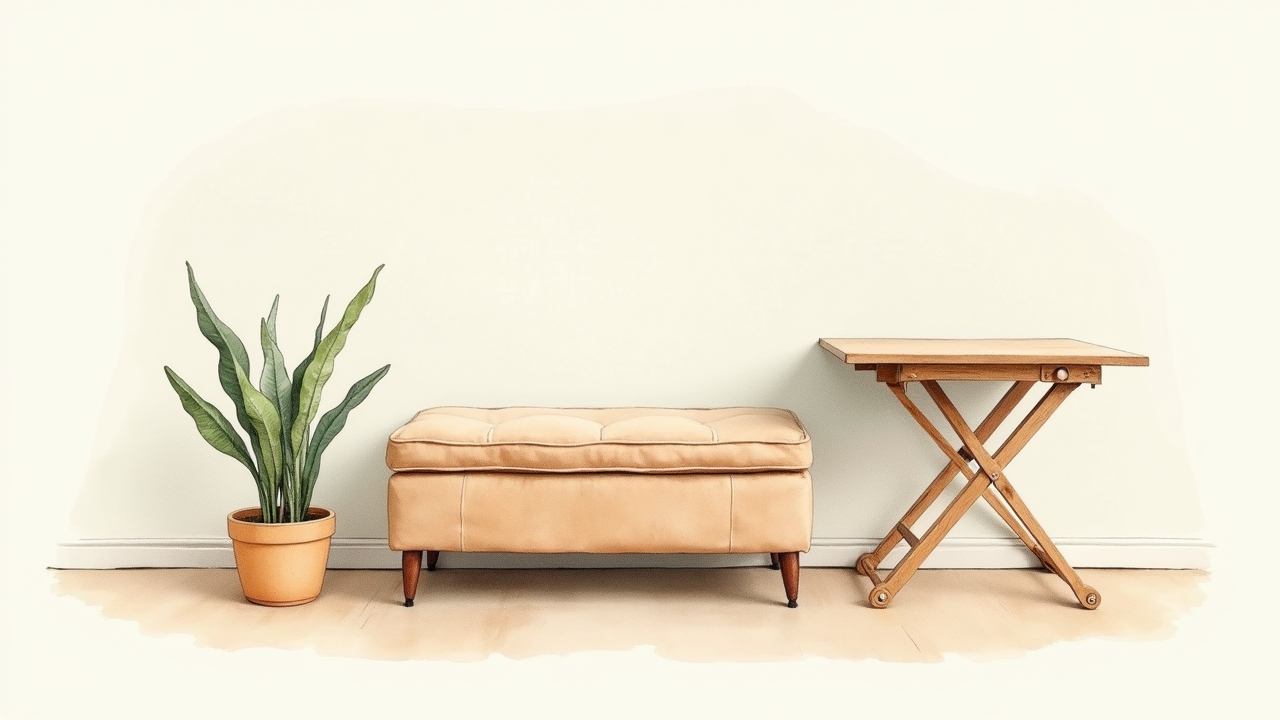
Furniture with exposed legs — Sofas and chairs with visible leg space (vs. skirted bases) create sightlines under furniture, reducing visual weight by ~15% (per Houzz designer survey).
-
Consistent flooring throughout — Avoid breaking the floor with rugs that match individual zones. A single large area rug (10x12 minimum for a studio) under all major furniture extends the visual floor.
The Murphy bed vs sofa bed math
The most-asked studio question. Houzz Pro 2024 data:
- Murphy bed pros: Frees 18-22 sq ft of floor space daily. Daytime studio feels 5% larger.
- Murphy bed cons: $800-$3,000 cost. Most require wall installation (drywall anchoring), which is rental-prohibited in 73% of US leases. Removal damages drywall.
- Sofa bed pros: $400-$1,200. Movable. No installation. Multifunctional daily.
- Sofa bed cons: Less comfortable for daily sleeping. Sofa frame compromises cushion comfort.
Decision rule: Long-term lease (3+ years) with landlord approval → Murphy bed. Standard rental → quality sofa bed (Article Sven Sleeper, IKEA FRIHETEN, West Elm Henry).
The cost stratification
Where to spend, where to save, per ASID guidance:

| Category | Recommended spend | Why |
|---|---|---|
| Mattress | 25% of total | Daily use, longest-lasting purchase |
| Sofa | 20% of total | Daily seating + frequent guest visibility |
| Lighting (3+ sources) | 15% of total | Defines zones, biggest mood impact |
| Storage | 15% of total | Determines whether the space stays clutter-free |
| Desk + chair | 10% of total | Posture matters for daily work |
| Decor | 10% of total | Renter’s investment to be left or moved |
| Rug | 5% of total | Anchors the relax zone |
For a $3,000 studio outfit: $750 mattress, $600 sofa, $450 lighting, $450 storage, $300 desk + chair, $300 decor, $150 rug.
Modular vs fixed — the resale data
For renters expecting to move within 3 years, modular furniture (Article Sven, West Elm Andes, IKEA Friheten) significantly outperforms fixed-frame on resale.
Apartment Therapy 2024 tracking of 1,200+ apartment moves:
- Modular pieces resell on Facebook Marketplace / Craigslist at 60-70% of retail price
- Fixed-frame pieces resell at 30-45% of retail price
- Custom-fitted pieces (built-in shelving, wall-mounted) often have $0 resale value (cost of removal exceeds piece value)
Over 2 moves in 5 years, the modular premium of 20-30% pays for itself in retained value plus reduced damage to walls during disassembly.
The bottom line
For a typical 400 sq ft studio in 2025:
- Layout — Three zones defined by furniture, not walls. Bed furthest from entry.
- Furniture — Modular pieces with exposed legs, multifunctional. IKEA NORDLI + FRIHETEN + NORDEN as a starting outfit.
- Visual expansion — Light walls, opposite-side mirror, ceiling-height curtains, consistent flooring.
- Budget — $2,500-3,000 total outfit. Front-load spend on mattress, sofa, lighting.
- Murphy vs sofa bed — Sofa bed unless you have multi-year lease with landlord approval.
The data converges across IKEA, ASID, and The Spruce on these five priorities. The rental-friendly subset of these recommendations works in 90%+ of US studio leases without requiring landlord cooperation.